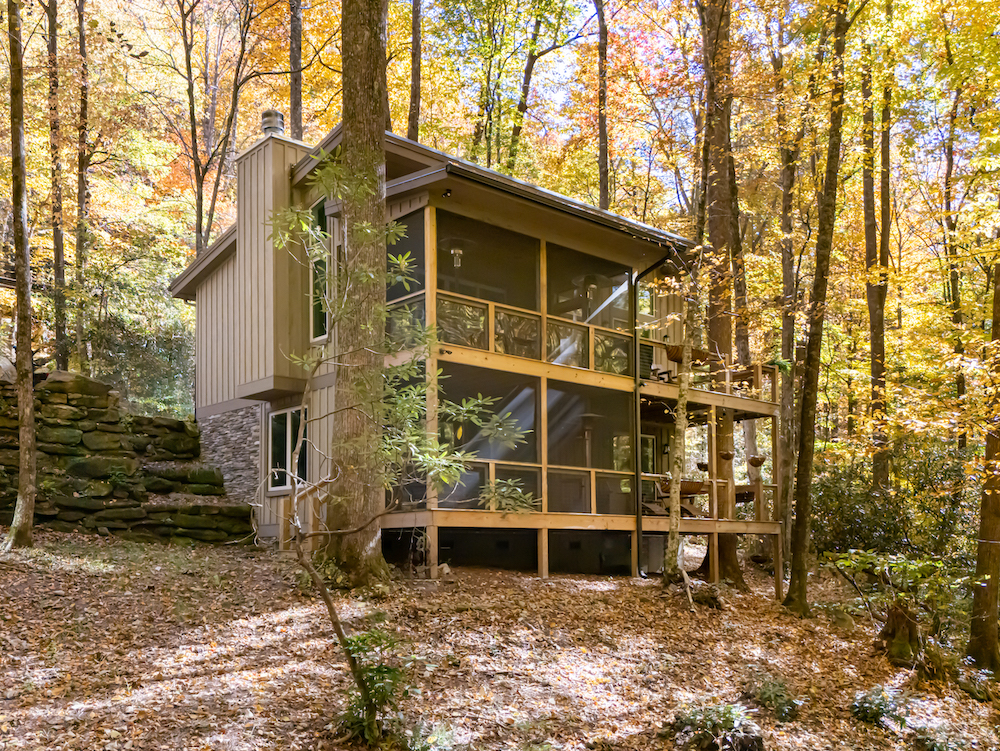
A 4,000-square-foot home built on a level lot outside Raleigh might run $325 per square foot. The same floor plan, built on a Plateau lot above Cashiers, will run closer to $550. Sometimes more.
That difference is not a builder marking up the project because the buyer is from out of town. It is the actual, line-by-line cost of putting a house on a mountain.
If you are coming to Western North Carolina from Florida, Atlanta, or one of the Piedmont metros, the numbers can feel high until you understand what is producing them. What follows is the explanation we wish more buyers had before their first builder conversation. None of it is theoretical. These are the line items that move budgets on real Plateau projects.
The Land Decides a Lot Before You Decide Anything Else
The single biggest reason a mountain build costs more than a flatland build is the ground it sits on.
A typical Piedmont lot is flat, has road frontage, has municipal water and sewer at the property line, and has soil that a foundation crew can dig into without much drama. The site prep on that lot might run $25,000 to $40,000.
A typical Plateau lot is some combination of sloped, wooded, distant from utilities, and underlain by granite. The site prep on that same project: same square footage, same eventual house: can run anywhere from $80,000 to over $300,000 before the foundation is even poured.
Here is what produces that range:
- Grading and excavation. Cutting a level building pad into a sloped lot takes equipment, time, and engineering. On steeper lots, you are moving thousands of cubic yards of earth, often into and out of access roads that did not exist three months earlier.
- Rock removal. Much of the Plateau sits on or near granite. When the excavator hits rock, the meter switches from a dirt rate to a rock rate, and rock comes out in one of three ways: slow grinding, hydraulic breaking, or controlled blasting. All three are expensive. On some lots, rock work alone can add $40,000 to $150,000.
- Retaining walls. Sloped lots need retaining structures to hold the building pad, the driveway cut, and sometimes the access route to the home. A serious engineered retaining wall is not a landscape feature: it is structural concrete and rebar designed to hold a hillside in place, and it gets engineered and inspected like any other load-bearing element.
- Driveway. Plateau driveways are often hundreds of feet long, sometimes a quarter mile or more. They require their own grading, base material, drainage, switchbacks on steep terrain, and a surface that holds up to winter weather and freeze-thaw cycles. A long mountain driveway can run $30,000 to $100,000 by itself.
None of this exists on a Piedmont lot. All of it is normal on a Plateau lot.
"People hear $80,000 for site work and they think we're padding the number. We're not. On a real mountain lot, by the time you've graded the pad, built the retaining walls, cut the driveway, and dealt with whatever rock the excavator finds, you can be six figures in before a single piece of framing lumber arrives. That's not the cost of building a house. That's the cost of making the land buildable."
Utilities Are Not Where You Want Them
Most Plateau buyers are surprised to learn that almost every custom home in the region depends on a well, a septic system, and sometimes a propane tank. not on municipal water, sewer, and natural gas.
- The well. A drilled well on the Plateau averages 300 to 600 feet, sometimes deeper. Cost runs $10,000 to $25,000 for the well itself, plus pump, pressure tank, and water line to the house. If the first attempt does not hit water at the right depth or volume, you drill again.
- The septic system. Septic on the Plateau is not a tank in the back yard. It is an engineered system that has to be approved by the county before the home can be permitted. Jackson County Environmental Health and Macon County Environmental Health both publish septic permitting requirements for their respective jurisdictions. Conventional septic systems run $8,000 to $15,000. On lots where soils, slope, or proximity to water do not support a conventional system, you are looking at engineered alternatives: low-pressure pipe systems, drip irrigation, or pump-up systems: that can run $25,000 to $50,000 or more.
- Power. Bringing electrical service to a remote homesite means trenching power lines from the road, sometimes hundreds of feet. Long runs can add $5,000 to $20,000.
- Propane. Most Plateau homes use propane for the cooktop, the water heater, the fireplace, and sometimes the heating system. The tank, the gas lines, and the initial fill add another line item.
Add these together and you are often at $35,000 to $100,000 in utilities alone. costs that on a Piedmont lot are simply not part of the conversation.
The Code and the Climate Both Cost Money
Western North Carolina mountains see real weather. Real snow, real wind, real freeze-thaw cycles, and real temperature swings. Homes built here are engineered for all of it.
- Snow load. Roof structures in our region are framed and rated for snow loads that a Charlotte builder never has to think about. That means heavier rafters, stronger trusses, and sometimes structural reinforcement that adds to the framing cost.
- Wind exposure. Ridge-line homes catch wind that valley homes do not. Window assemblies, roofing fasteners, and exterior cladding all get specified accordingly.
- Insulation and the building envelope. A home expected to sit through Plateau winters needs serious insulation, well-detailed air sealing, and a thermal envelope that performs in temperatures that drop below freezing for weeks at a time. Spray foam, advanced wall systems, and high-performance windows all cost more than the builder-grade equivalents used in milder climates. The EPA's ENERGY STAR Certified Homes program outlines the envelope performance benchmarks that well-built mountain homes routinely meet or exceed.
- Foundations. Foundations have to extend below the frost line, and on rocky or sloped lots they often need engineered footings, stepped walls, or deeper structural systems than a flat-lot foundation would require.
These elements are not optional. They are what makes the home actually function and last through Plateau weather. They are also what separates a properly built mountain home from a flat-lot floor plan dropped into a mountain setting: a mistake that costs the buyer more in the long run than the savings on day one.
The Materials and the Trades
The finishes that look natural in a mountain home: heavy timber, stone, standing-seam metal roofing, real wood interiors: are more expensive than the lighter, simpler materials used on lower-elevation builds. That is partly because the materials themselves cost more, and partly because they take more skilled labor to install correctly.
Western North Carolina also has a smaller pool of high-end trades than a major metro. The framers, masons, finish carpenters, and electricians who do top-quality work on the Plateau stay booked. Their rates reflect that. Bringing trades from outside the region adds travel costs and per diem to the job.
This is why two homes with similar plans can finish at very different numbers. The land is half the story. The other half is what gets installed on top of the foundation, and who installs it.
"There is no shortcut up here. You can't cut the retaining wall, you can't skip the well, you can't pretend the snow load is the same as Raleigh's. Every one of those line items is doing real work in your house, and every one of them is what makes the difference between a home that lasts forty winters and one that doesn't. When buyers ask me what they're paying for, that's the answer. They're paying for a home that fits the mountain it's built on."
What This Means for Your Project
If you are working through a budget for a Plateau custom home, the right way to think about it is in three buckets, not one.
- The house itself. Framing, the envelope, the systems, and the finishes. Most of the per-square-foot conversation lives here.
- The land work. Site prep, retaining, driveway, well, septic, and utilities. On a serious mountain lot this can be 15 to 25 percent of the total construction budget, sometimes more. On a flat-lot Piedmont project it would be five percent.
- The contingencies. Mountain lots produce surprises. Good builders walk the land before they quote so the number is as accurate as it can be. Even so, a 5 to 10 percent contingency reserve is reasonable on a mountain project. It is not pessimism. It is math.
When you put these buckets together, the per-square-foot number that looked high in isolation makes more sense. You are paying for the land work that flatland projects do not require, the engineering and materials that mountain weather demands, and the trades who actually know how to build a home that will sit through forty winters above 3,000 feet.
A Plateau custom home costs more because it has to. What you are paying for is exactly what makes the home worth owning in the first place.
Russ and Will Powell · Powell Construction, Inc. · Serving Sapphire Valley, Cashiers, Highlands, Lake Toxaway, and Glenville.