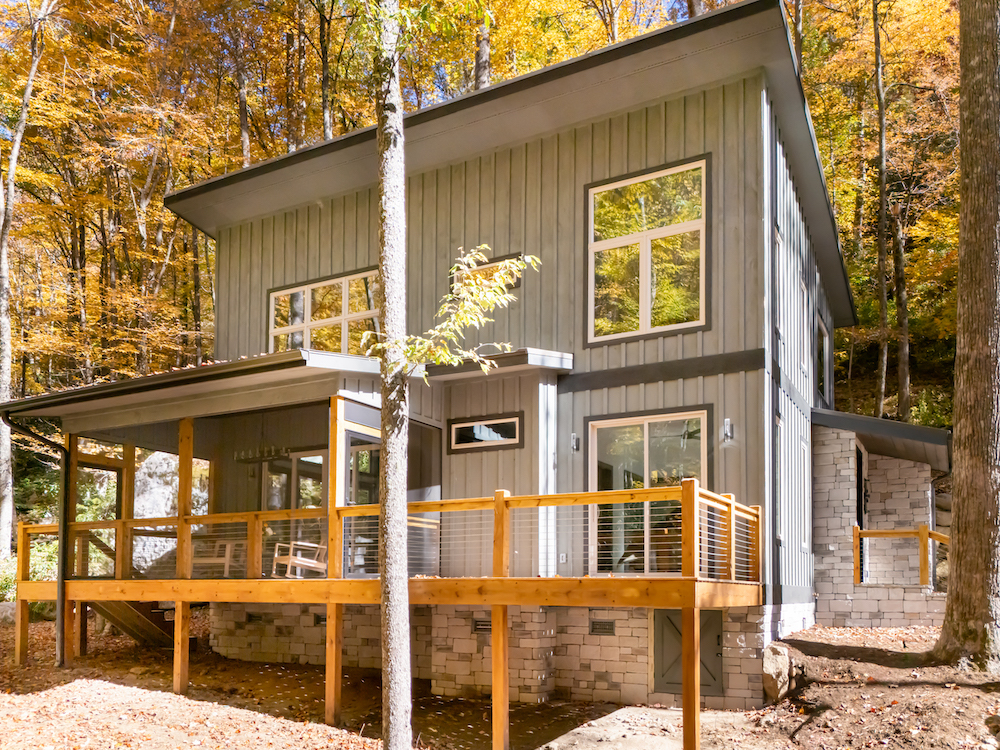
If you are reading this from a desk in Tampa, Atlanta, Charlotte, Raleigh, or Nashville, you are exactly the kind of client we work with most weeks. A good portion of the custom homes we build on the Highlands-Cashiers Plateau are for buyers who live somewhere else: primary home four to seven hours away, mountain home being built in Sapphire, Cashiers, Highlands, Lake Toxaway, or Glenville.
The question we get most often on a first call is some version of: how does this actually work when I cannot drive up there every Saturday?
It works fine. Better than fine, usually. Forty years of building on the Plateau has taught us how to keep an out-of-state client genuinely in the loop without burying them in email, and how to make decisions on their behalf in the moments when waiting is not an option. Here is what that looks like in practice.
Who Builds From Away
Our out-of-state clients fall into three rough groups:
- The second-home buyer. Often 55 and up, family raised, primary home in Florida or a Southeastern metro. The Plateau home is a retreat, a long-term family asset, sometimes eventually a full-time residence.
- The relocating retiree. Selling the primary, moving full-time to the Plateau within 12 to 18 months. Often arriving from Charlotte, Atlanta, or further. The build coincides with a life transition.
- The long-term investor. Less common but consistent. Building a high-quality custom home as a long-term real estate hold, often with eventual second-home or family use.
What unites all three is the geography. They are not coming up every week to walk the site. The build has to work without that, and it has to work in a way that does not require a leap of faith.
The Communication Rhythm
This is where most builders fail out-of-state clients, and it is where we work hardest.
Our standard cadence for an out-of-state project includes a weekly Thursday update: photos of progress that week, a short written summary of what got done and what is coming up, and a flag for any decisions approaching their window. Sent before end of day Thursday so you can review over the weekend if you want, or first thing Monday if that fits your week better.
Beyond the weekly update, we work in a few other rhythms:
- Two-week lead time on selection decisions. When a finish or material decision is coming up, you get a heads-up at least two weeks ahead. What is needed, when it is needed, what we are recommending. No same-day surprises about cabinet stain or tile selection.
- Real-time alerts when something matters. Site issue, schedule change, inspection result, material delay. You hear it from us before you would have heard it from anyone else.
- A direct line. Russ and Will both have their cell numbers published on the contact page. Out-of-state clients call them. We answer.
The Thursday update is the keystone. Most out-of-state clients tell us, a few months in, that the Thursday update is the thing that lets them stop thinking about the build for the rest of the week. They open it, see where the project stands, and go about their lives. The point is not that we are sending a lot of content. The point is that you always know where the project stands, on a predictable schedule, without having to ask.
Decisions That Can Wait, and Decisions That Cannot
A common worry: what happens when a decision comes up and I am not there?
We sort decisions into three categories so you know in advance how each one will be handled.
Decisions you always weigh in on
Floor plan changes, even small ones. Material substitutions on visible finishes: cabinetry, stone, tile, flooring, lighting, plumbing fixtures, exterior cladding, roofing. Anything that meaningfully changes the project budget or moves your move-in date. These are your decisions. We bring them to you, we recommend, you decide.
Decisions we make on your behalf without escalating
Routine framing detail and structural framing methods inside the wall. Sequencing: which sub goes when, when materials are scheduled to arrive. Equivalent material substitutions when a supplier is out (same-grade lumber from a different mill, for example). Small site-condition adjustments that fall inside the approved construction documents. These are routine builder calls. Escalating them slows the project without adding value to you.
Decisions we discuss first but expect to move on quickly
Sub crew assignments. Color or finish substitutions when the specified option is back-ordered and waiting would push the schedule. Vendor changes if a sub is underperforming. These are middle-ground calls. We want your input, but the project benefits from quick turnaround, so we will look for a yes or no within a day or two rather than waiting a week.
The middle category is where trust matters most. An out-of-state client cannot reasonably weigh in on every routine call, and a builder who escalates every decision is a builder who is not actually managing the project. The first conversation we have with every new client is about this list: what we will decide on your behalf, what we will not, and where the lines are.
Site Visits: How Often, and What They Are For
Most of our out-of-state clients come to the Plateau three or four times during a typical 14- to 18-month build. The specific cadence is flexible, but the four visits that genuinely matter are:
- Pre-construction walk. Before we break ground. We walk the lot together, talk through the final plan, mark the building corners, and point out anything we noticed during permitting that you should know about.
- Framing walk. When the structure is up but before drywall. This is your chance to walk through the rooms in three dimensions before they get closed in. We catch most adjustments at this stage.
- Pre-drywall mechanical walk. Electrical, plumbing, HVAC, and low-voltage are roughed in. You verify outlet locations, switch placements, fixture rough-ins. Much easier to move things now than after drywall.
- Final walk. Before move-in. Punch list, systems walk-through, paperwork, handoff.
Some clients add visits between these. Some do not need to. We are flexible. The point of the visits is to catch things that photos and videos cannot communicate, not to satisfy a schedule.
If you cannot make a visit, we will do a live video walkthrough at the same scheduled time. Not ideal, but it works. We have walked clients through framing over FaceTime more than once.
What Goes Wrong, Honestly
The honest version of out-of-state building includes the things that go wrong. We would rather tell you about these on the front end than have you discover them mid-build.
- A sub will miss a day or a week. Trades on the Plateau are excellent, but they are also in high demand. Sometimes a crew gets delayed on a previous job. We build buffer into the schedule for this. Expect it without being alarmed.
- Materials get delayed. Specialty items: imported tile, custom windows, specific cabinetry lines, occasionally ship late. We order long-lead items early to minimize this, but it happens.
- Weather affects the schedule. Snow and ice in winter, fog and heavy rain in shoulder seasons. We work through most of it. Some weeks we lose a day or two. Part of building at elevation.
- A site condition surprises us. Even with careful planning, mountain sites occasionally reveal something during excavation that requires an engineering adjustment. We tell you immediately, we tell you what it costs, you decide.
What does not happen, if we are doing our job, you find out about any of these from someone other than us, weeks after the fact. The deal is that you hear it from us, in plain language, when it matters, with a recommendation for what to do about it. That standard does not change when you are 500 miles away. It is the standard either way.
Why Distance Sometimes Works in Your Favor
A small contrarian observation, four decades in, out-of-state clients often end up at least as happy with their builds as local clients do. Sometimes happier.
The reason is that distance forces structure. The Thursday updates, the scheduled visits, the documented decisions, the agreed-upon decision categories. These are the disciplines that make a build go smoothly. When a client lives 20 minutes away and drops in twice a week, the build sometimes runs on informal communication, undocumented decisions, and weekend conversations that do not get written down. By the end, no one is quite sure who decided what.
Out-of-state clients do not have that option. The process is more formal, and the project benefits.
This does not mean every out-of-state buyer loves the experience equally. Buyers who genuinely struggle with not seeing things in person, who get anxious when they cannot intervene mid-week, sometimes find the experience harder. But the buyers who can settle into the rhythm: read the Thursday update, make the decisions when they come up, trust the process between visits, tend to end the project with a home they love and a relationship with their builder they are glad they have.
What a First Conversation Looks Like
If you are planning a Plateau build from out of state, the first conversation is the same as it would be if you lived locally. Tell us about the land you are considering or already own, the kind of home you have in mind, the timeline, the budget range. We will tell you honestly what to expect, what we can do, and where we think your project lands within the range.
We will also tell you what we cannot do, if that comes up. Some clients are not a fit for our process, and we would rather have that conversation early than three months into a build.
Call us or send a note. The first conversation is free, and the earlier the better.
Russ Henkel · (828) 226-7226 · Will Powell · (828) 506-7519
Powell Construction, Inc. · Serving Sapphire Valley, Cashiers, Highlands, Lake Toxaway, and Glenville.