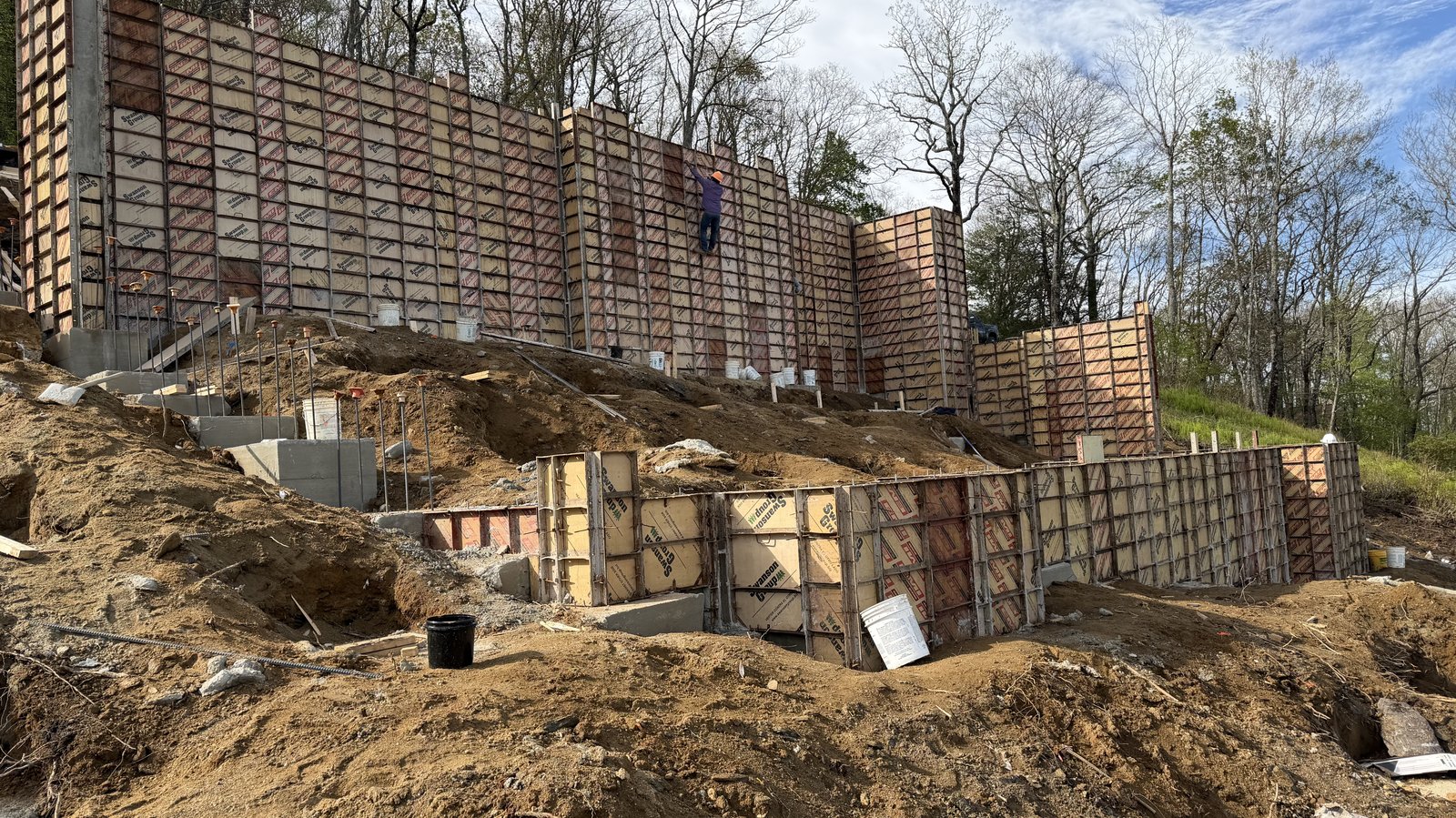
Site preparation is the largest single variable in a Plateau custom home budget, and the line item buyers understand the least. Two lots that look similar from the road can land $200,000 apart on site work alone. Here is what is actually inside that line item, why the numbers swing so widely, and what to look at before you buy the land.
If you have read our earlier articles on why a mountain build costs more and what moves your build within the range, you have seen site work mentioned as the lever that sets the floor on your per-square-foot number. This article is the long version of that conversation, written for buyers who want to understand what they are actually paying for.
Why Site Work Is Different Up Here
If you have built before in Florida, Texas, or anywhere on flat land, your mental model of site work is probably: grade the lot, pour the slab, run the utilities a short distance to the road, done. Maybe $40,000 to $60,000 of work, often less.
That model does not transfer to the Highlands-Cashiers Plateau. Site work here is six or seven distinct subcategories, several of which barely exist in flatland markets:
- Excavation and grading on terrain that is rarely flat to start with
- Rock removal, almost always
- Retaining walls, often more than one
- Driveway construction that can run hundreds of feet uphill
- Engineered septic systems, because conventional ones rarely perc up here
- Well drilling and pump systems, because most lots are not on municipal water
- Stormwater management and erosion control, required by code and by physics
Each of these is its own line item with its own crew, its own equipment, and its own range of costs. None of them are optional. The buildable Plateau lot at $80,000 in site work and the difficult Plateau lot at $400,000 are using the same list of subcategories. The difference is how much of each the land requires.
What Site Work Actually Costs, Line by Line
Approximate ranges for a typical Plateau custom home, based on the projects we have built. Your specific numbers depend on the lot, the access, the home design, and what we find during excavation.
Excavation and grading
Cutting the building pad, balancing cut and fill, shaping the lot for drainage. On a moderately sloped lot, $25,000 to $60,000. On steep terrain or where significant earthmoving is required, $75,000 to $150,000.
Rock removal
The Plateau sits on granite. Most lots have rock within a few feet of the surface, often less. The question is not whether you will hit rock during excavation. It is how much, and how hard. Light rock that can be excavated with a hydraulic breaker runs $20 to $60 per cubic yard. Hard granite that requires sustained breaking or blasting can run $100+ per cubic yard. A single rocky building pad can generate $30,000 to $150,000 in rock removal costs that none of the cosmetic site-survey photos hinted at.
Retaining walls
A retaining wall is not decoration. It is a structural element that holds back a slope so the home and the driveway can exist where you want them. Engineered concrete or block walls run $40 to $120 per square foot of wall face, depending on height, soil pressure, and reinforcement requirements. A 100-foot retaining wall, 8 feet tall, is roughly $50,000 to $90,000 by itself. Some lots need two or three.
Driveway
Plateau lots are usually set back from the road. A 400-foot driveway is common. A 1,000-foot driveway is not unusual. Driveway construction includes clearing, base preparation, drainage, retaining where needed, and a paved or compacted gravel finish. $50 to $90 per linear foot for asphalt, $25 to $50 per linear foot for compacted gravel. A 600-foot asphalt driveway is $30,000 to $50,000 before any uphill complexity or culverts are factored in.
Septic system
Almost every Plateau lot is on septic. Conventional gravity-flow septic systems require specific soil conditions and slope, which Plateau lots rarely meet. Most lots end up with an engineered alternative system: drip dispersal, low-pressure pipe, or in some cases an aerated treatment unit. Conventional systems where they fit: $15,000 to $25,000. Engineered alternatives: $25,000 to $60,000. Systems on difficult sites with poor soil or limited area: $60,000+.
Well
Most Plateau lots are also off municipal water. A drilled well includes the borehole, casing, pump, pressure tank, and water line to the home. Typical depth on the Plateau is 200 to 600 feet, occasionally deeper. $12,000 to $25,000 for a standard well. Wells that need to go deeper, or that need treatment systems for hardness or sediment, can run $30,000 to $50,000.
Utilities and stormwater
Power and any communications lines run from the road to the home. On long driveways, this is often a trenched run of several hundred feet. Stormwater management includes culverts under the driveway, swales to direct runoff, and erosion control during and after construction. Combined, $15,000 to $50,000 depending on lot size, slope, and length of run.
Add those up on a typical Plateau lot and you arrive at the $80,000 to $400,000 range we have referenced in prior articles. Two-thirds of that swing is driven by three categories: rock, retaining, and septic.
The Granite Question
Rock is the single most common budget surprise on Plateau builds. Buyers see the site walk, the lot looks reasonable, and the surface gives no clear indication of what is six feet down. Then the excavator hits granite, the schedule slows down, and the rock removal line item starts climbing.
An experienced builder can read the signs before excavation. Exposed rock outcroppings nearby. Trees that grow in a particular way around shallow bedrock. Soil color and depth in the cut banks along the driveway. Where neighbors hit rock during their own builds. None of these are perfect, but together they let an experienced eye estimate the rock risk within a usable range.
The buyers who get caught off guard are usually the ones whose builder did not look for these signs, or who treated rock as a contingency to mention later rather than a variable to price up front. Our estimates include a specific rock allowance based on what we observed during the site walk. If we find more rock than expected, you hear about it immediately, with a number. If we find less, the contingency comes back to you.
The Slope Question
Slope affects almost every line item in site work, not just one. A steeper lot means more excavation, more retaining, more driveway switchbacks, more challenging access for trucks and equipment, more complex stormwater management, and more difficult crew logistics. Two lots with the same square footage can run dramatically different site-work numbers because one of them sits at 8% grade and the other sits at 25%.
Slope also affects what the home can be. On a steep lot, the foundation steps. The garage often sits below the main floor. The driveway has to bend. The walkout basement becomes a structural decision rather than a stylistic one. None of this is bad, but all of it costs more than building on flat ground, and the cost shows up across every site-work category at once.
The Septic Question
Septic is the line item with the longest tail in time, not just dollars. A conventional septic system can be designed and approved in weeks. An engineered alternative can take three to six months from soil test to permit, depending on the county, the system type, and how busy the engineering firm is. We have had projects sit, fully ready to break ground, while the septic permit worked through approval.
The first conversation we have with a buyer on a new lot is almost always about septic. Soil tests are inexpensive and tell us a lot about what kind of system the lot will support before any other decisions get made. The USDA's Web Soil Survey can give you a free preliminary look at the soil under a lot, but a formal site evaluation by a licensed septic evaluator is what actually drives the permit. If you are looking at land and a builder has not asked about septic before talking about floor plans, that is worth noticing.
"Forty years of walking lots up here, and I still find something on almost every one that nobody saw coming. The difference between a good site estimate and a bad one is not whether you missed something. It is whether you priced in a contingency that covers what you missed. The buyers who get hurt are not the ones whose builder found a problem. They are the ones whose builder pretended the problem would not exist."
How We Estimate Site Work
Our site estimate starts with a walk. Not a drive-by, not a desk review of survey documents. A walk, usually two to three hours, often with a soil scientist or septic engineer along if the lot has known issues.
On the walk, we look at:
- The proposed building location and its terrain, including any exposed rock or terrain signs
- The driveway path, including length, slope, any drainage crossings, and access for construction equipment
- The septic area, both the primary and the backup repair area required by code
- The well location, including distance from septic (state code requires minimums)
- Utility routing from the road or nearest service point
- Stormwater patterns, including where water flows during a heavy rain and where it goes after
- Tree clearing, both required and optional, and what we leave to protect the home from wind exposure
After the walk, the site estimate breaks out as discrete line items with the ranges and rationale we used. The number is an honest range, not a single figure, because we are estimating excavation outcomes before any excavation has happened. The contingency is built in, and we tell you what it is for.
If you are looking at land you do not yet own, we can walk it before you buy. A few hundred dollars of our time can save you a six-figure surprise after closing.
What to Do Before You Buy Land
If you are at the land-shopping stage, three questions are worth answering before you write an offer:
- What kind of septic will this lot support? A soil test from a licensed septic evaluator runs $400 to $800 and tells you most of what you need to know. Worth doing as a contingency on the offer rather than after closing.
- What does the site work likely cost? A builder walk-through is the most reliable way to get this number. Real estate agents and sellers will give you optimistic estimates. Builders who walk the land will give you an honest range.
- Where is water, and where is power? A long utility run is not a deal-breaker, but it is a budget item. Know it before you buy.
The lots that turn into the best builds are usually not the cheapest lots. They are the lots where the buyer understood the site work picture clearly before closing, and built a budget that included it from the start. The buyers who get burned are almost always the ones who bought based on land price alone and discovered site work later.
The Bottom Line
Site preparation on the Highlands-Cashiers Plateau runs $80,000 on a relatively buildable lot and can run $400,000+ on a difficult one. The spread is real, the math is honest, and the number for your project comes from walking your specific land with someone who knows what they are looking at.
If you are at the land stage, or under contract on a lot and trying to budget realistically, we will walk it with you. The first conversation is free, and the earlier in the process we have it, the better.
Russ Henkel · (828) 226-7226 · Will Powell · (828) 506-7519
Powell Construction, Inc. · Serving Sapphire Valley, Cashiers, Highlands, Lake Toxaway, and Glenville.