A Plateau custom home takes 14 to 18 months from signed contract to keys, sometimes longer on complex projects. That is a long time to live with a project you cannot see every week, and most of the timeline anxiety we encounter comes from buyers not knowing what month is supposed to feel like. Here is the realistic picture: what each phase actually involves, when things look like they are not moving, and when they are.
If you are building from out of state, this article is the calendar that goes with that one. You can use it to know roughly what to expect from each month's Thursday update, and where in the schedule to plan your site visits.
The Three Phases of a Plateau Build
Most buyers think of a build as one long stretch of construction. In practice, it breaks into three distinct phases, each with its own pace:
- Pre-construction (months 1 to 3). Survey, design finalization, permitting, septic approval, lot preparation planning. Almost no visible activity on the lot. Feels like waiting. Is not.
- Construction (months 4 to 14). Site work, foundation, framing, dry-in, mechanical, finishes. Visible progress every week, but with pace shifts between phases.
- Close-out (months 15 to 18). Final inspection, punch list, certificate of occupancy, walk-through, keys.
The first phase is the one buyers usually undervalue. The work that happens in months 1 to 3 sets up everything that follows. Permits that are sloppily prepared cause delays in month 8. Septic systems that were not designed early enough delay foundation in month 5. The early phase looks slow because it is not generating Instagram-worthy photos, but it is doing the work that lets the visible phases move on schedule.
Month 1: Contract, Survey, and Design Lock
The first month is paperwork-heavy. Contract signed, deposit deposited, project officially started. We order a topographic survey if one does not exist, finalize the construction documents with the architect, and start the long list of pre-permit submissions.
From the buyer's side, this is the month of final decisions on architectural details, finish-level direction, and budget alignment. Out-of-state buyers can usually handle month 1 entirely by email, video call, and signed PDF.
Months 2 and 3: Permits, Septic, and Site Investigation
These are the months that test patience. We are working hard, but visibly nothing is happening on the lot. What is actually happening:
- Building permit submission and review with Jackson or Transylvania County
- Septic permit, often the longest pole in this phase. Engineered systems can run 8 to 16 weeks from soil test to approval
- Well drilling permit and well drilling (well can happen in parallel with septic approval)
- Driveway permit if a new entrance is needed
- Erosion control plan and stormwater approval
- Final selection of long-lead items: windows, specific cabinetry lines, custom doors
The long-lead selections matter. Custom windows on a glass-heavy mountain home can take 12 to 20 weeks to fabricate and deliver. We order them now so they arrive before framing finishes, not after. Same for fully custom cabinetry, imported tile lots, and any specialty materials.
If you are out of state, this is the phase where you might wonder if anything is happening. Your Thursday updates will mostly say "permits in review" or "septic engineering submitted." That is the right answer, not a sign of trouble.
Month 4: Site Work and Foundation
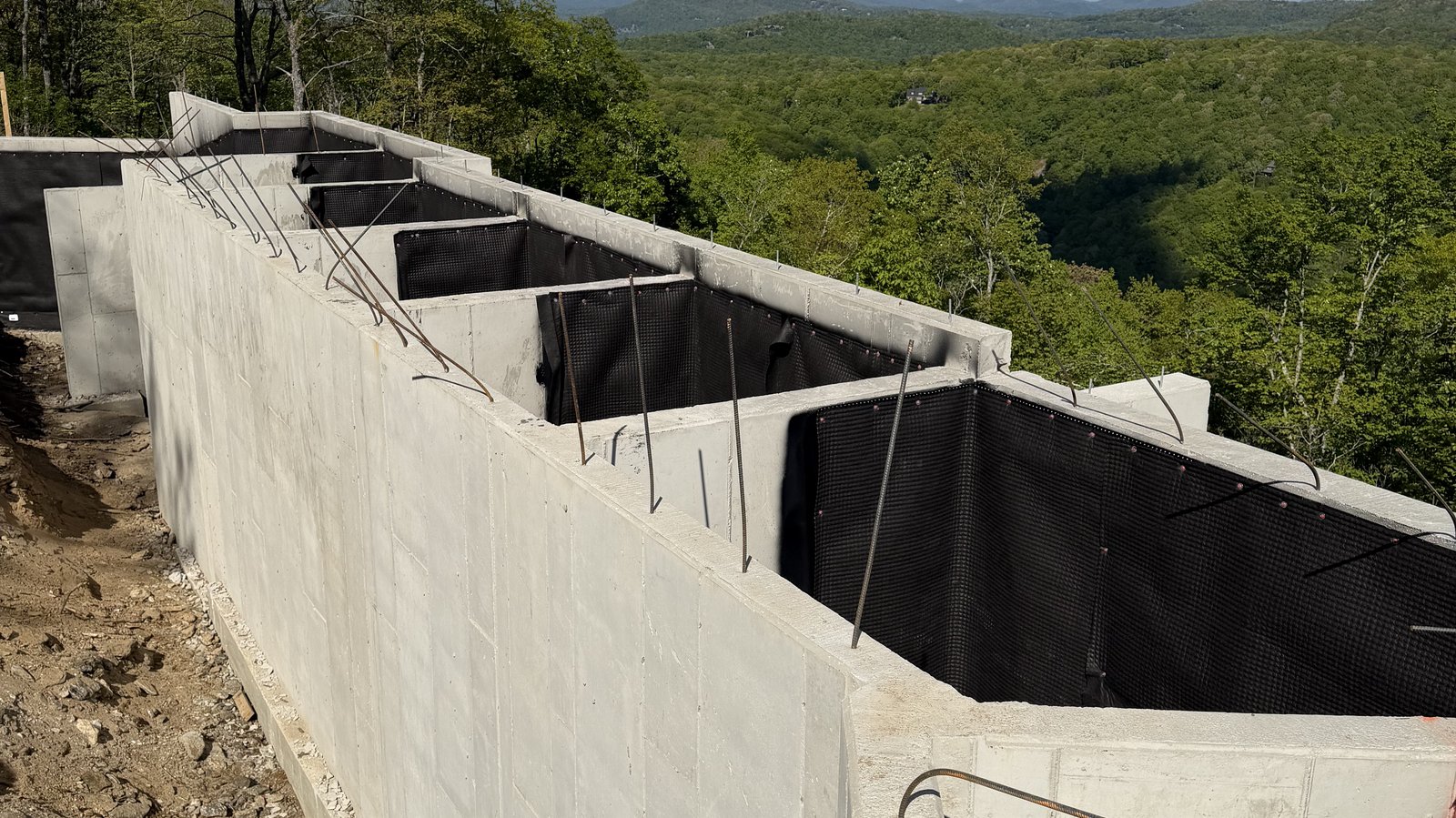
The first month of visible progress. Site work crews arrive: clearing, excavation, rock removal, retaining walls, driveway base preparation. This is the heavy-equipment phase that we covered in detail in the site preparation article.
By the end of month 4, the foundation is poured. The site that was wooded four weeks ago now has a concrete shape on it that looks like the start of a house. This is the most exciting month for most buyers. Your Thursday updates suddenly have dramatic photos.
It is also the month where any site surprises surface. We tell you immediately if we find more rock than expected, or if a soil condition requires an engineering adjustment.
Months 5 and 6: Framing
Framing is the phase that looks the most dramatic in photos but moves at a deceptively measured pace. A custom Plateau home of 3,500 to 5,000 square feet typically frames in 6 to 10 weeks, depending on architectural complexity.
Month 5 starts with the first walls going up. Month 6 ends with the structure fully framed, sheathed, and roofed. By the end of month 6, you can walk through the rooms in three dimensions for the first time. This is one of the four site visits we recommend out-of-state buyers make in person if they can.
Months 7 and 8: Mechanical Rough-In and Dry-In
This is the phase buyers most often misjudge. The home looks finished from the outside. Roofing is on. Siding is going up. Windows and doors are installed. From the photos, it looks done.
It is not. The inside is wide open studs, and the next two months are spent installing the systems that make the home actually function: electrical rough-in, plumbing rough-in, HVAC ductwork and equipment, low-voltage and data wiring, in-floor heating systems if specified.
This is also when the second critical site visit happens: the pre-drywall mechanical walk-through. We walk every room and confirm outlet locations, switch placements, fixture rough-in heights, low-voltage drops. Moving an outlet now costs almost nothing. Moving it after drywall costs significantly more. Out-of-state buyers who can come for this visit are glad they did.
Months 9 to 13: Interior Build-Out
The long phase. Five months of steady, less-dramatic-photo interior work. Drywall first, then trim, cabinetry, tile, flooring, paint, lighting installation, plumbing fixtures, doors and hardware. Each trade overlaps with the next, and the home transforms steadily but without the dramatic week-to-week jumps of the framing phase.
This is also the phase where most schedule slippage tends to happen. Not because anything is going wrong, but because cumulative small delays add up: a cabinetry shipment a week late, a tile order on backorder, a paint specification that needed a sample correction. None of these are catastrophic individually. Across five months, they can move the move-in date.
For out-of-state buyers, this phase is mostly Thursday updates of "drywall mudding finished in primary bath," "trim carpenter starting Monday on great room," "tile installer on site this week." Steady, predictable, undramatic. Exactly what it should look like.
Months 14 and 15: Final Push and Punch List
The pace changes again. Everything that was a slow long phase is now a sprint. Final inspections happen one after another: electrical, plumbing, mechanical, building. The systems get commissioned. Appliances get installed. Final paint touch-ups. Final cleaning.
The punch list is the document that captures everything that needs to be perfect before handoff. We generate it. You generate one when you walk the home. We work through them together. Most punch lists run 40 to 80 items. Some are 15 minutes of work; some are a half-day. We work through them until the list is empty.
This is the third site visit we strongly recommend in person: the punch-list walk. Even buyers who could not make any other visits typically come for this one.
Months 16 to 18: Certificate of Occupancy, Walk-Through, and Keys
The final phase is administrative more than physical. Certificate of occupancy issued by the county. Final lien releases. Warranty documentation. Systems orientation. Then the walk-through where we hand you the keys, walk every room together, show you where every shut-off and switch is, and answer questions.
For out-of-state buyers, the final walk-through is the fourth and most important in-person visit. Plan it for a stretch when you can actually move in, not a long-weekend trip that requires you to leave again.
What Typically Causes Delays
Eighteen months is the realistic upper end. Most of our builds finish within 14 to 16. The projects that stretch toward the upper end of the range usually do so for one of these reasons:
- Septic engineering took longer than expected. The most common pre-construction delay. Sometimes the lot needs a system that requires extra review time.
- Material delays on long-lead items. Custom windows, specific cabinetry lines, imported finish materials. We order early to minimize this, but it still happens.
- Selection decisions that did not get made in time. A finish decision delayed by two weeks does not delay a build by two weeks. It delays the trade that was scheduled for that item, which delays the next trade, which delays the trade after that. Compound delays are the silent killers of build timelines.
- Weather. Snow, ice, and prolonged heavy rain on the Plateau cost us days, sometimes weeks. We build buffer into the schedule, but a hard winter can still move things.
- Change orders during construction. A floor plan change in month 8 will move the schedule. Sometimes the buyer's request justifies the delay, sometimes it does not, but a change is a change. The honest conversation about what it costs in time should happen before the change order gets signed.
"The buyers who are happiest with their timeline are the ones who made their selection decisions on schedule, did not change the floor plan after we started, and trusted the process during the slow months. The buyers who get frustrated are usually the ones who held up a selection for three weeks in month seven and then asked why month thirteen was running behind. The math is simple. The timeline is mostly within your control as the buyer, and we will tell you when a decision is on the critical path."
What You Can Do to Help the Timeline
The single most useful thing a buyer can do to keep a build on schedule is make selection decisions when they are scheduled, not when they feel ready. We will give you the deadline well in advance. The decision matters less than the timing. A "B+" decision made on schedule produces a better outcome than an "A" decision made three weeks late, because the late decision pushes every subsequent trade.
The second most useful thing is to resist the urge to change the floor plan once construction has started. Small adjustments are possible; structural changes are expensive in both money and time. The plan you signed off on in month one is the plan we are building. If something looks wrong during framing, tell us immediately; we can usually adjust before the cost gets significant. If you wait until drywall is up, the same change costs ten times more.
And third: trust the slow months. Pre-construction looks like nothing is happening. The interior build-out month 11 looks like nothing has changed since month 10. The Thursday updates will reflect what is actually going on, and our job is to make sure you know whether the project is on schedule or not. If we are on schedule, you can stop refreshing the photos.
The Bottom Line
A 14- to 18-month Plateau custom home build is a long project, but it is a predictable one when it is run well. The phases are knowable, the slow months are explainable, and the things that cause delays are the same handful of variables on almost every project.
If you are planning a build and trying to understand what to expect, the calendar above is the realistic picture. If you are already under construction and trying to figure out whether your project is on track, your builder should be able to tell you exactly where you are in the sequence and whether the cumulative slippage is meaningful. If they cannot, that is a separate problem worth addressing.
Russ Henkel · (828) 226-7226 · Will Powell · (828) 506-7519
Powell Construction, Inc. · Serving Sapphire Valley, Cashiers, Highlands, Lake Toxaway, and Glenville.