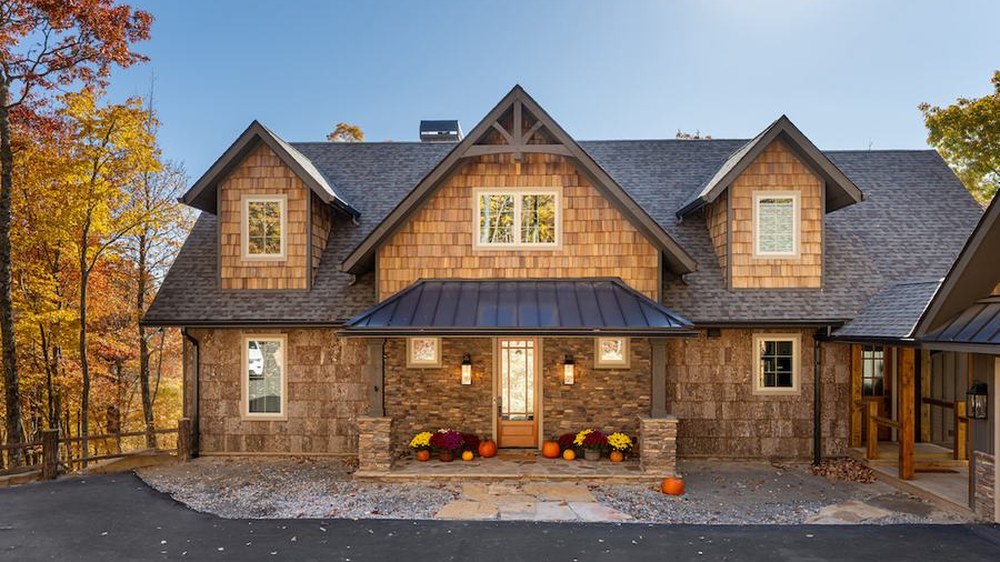
A custom home gets built twice. First on paper, in the estimate and the contract. Then on the lot. The builder you choose decides how closely those two versions match, and on the Highlands-Cashiers Plateau the gap between them can be wide.
If you read the fine print and want to know where every dollar goes before you sign, this is for you. We take eight checks in the order that protects you most: the license, the estimate, the contract, the allowances, the lot, the track record, the people, and the bids. Seven questions to carry into every meeting are collected at the end.
Start With the License
North Carolina requires a general contractor license for any project where the cost of the undertaking is $40,000 or more, as set out in G.S. 87-1. A custom home is far past that line, so the license is the first thing to confirm, and the NC Licensing Board for General Contractors is where to confirm it.
Check the classification too. Under G.S. 87-10, a limited license covers a single project valued up to $750,000, an intermediate license up to $1,500,000, and an unlimited license carries no project-value restriction. Land and ancillary land improvements are excluded. Plateau custom homes run $450 to $850+ per square foot, so the classification has to cover the real project value. Powell holds an Unlimited license, #104609.
You may also hear about the state's Homeowners Recovery Fund. It can reimburse a loss caused by a licensed general contractor's dishonest or incompetent conduct, but only after civil remedies are exhausted, and payment is at the Board's discretion, per Article 1A of Chapter 87. It is a last resort, not a safeguard. The safeguard is choosing well.
Ask How the Number Was Built
A price without a build-up is just a number. Ask to see the estimate as line items, with site work and foundation shown separately. On a mountain lot, site preparation and foundation work alone can represent 20 to 30% of the total build cost, compared with 8 to 12% on a flat lot. A bid that lumps those costs together, or leaves them thin, deserves questions.
Our own estimates are full line item, with site prep and foundation costs clearly broken out and no hidden categories. That is step three of our process, and it exists because we give you the real number from day one, even if it costs us the bid. For the longer version of how to read a builder's number, start with The Accurate Estimate vs the Low Bid.
Know Which Kind of Contract You Are Signing
A fixed-price contract sets one price for a defined scope. A cost-plus contract bills actual costs plus a fee, sometimes with a cap. Neither is wrong. They place the risk in different spots: with the builder in the first case, with you in the second. Know which one you are being offered, and what happens to the price when something changes.
Ask for the change order process in writing: who can authorize a change, how it is priced, and how you approve it before the work happens. Some builders bid low to win the job and make it up in change orders. The change order language is where you can see whether that is possible, so read it as carefully as you read the price.
Look at Every Allowance
An allowance is a placeholder budget for something you have not chosen yet: tile, lighting, plumbing fixtures, appliances, cabinets. If an allowance is set below what you will actually select, the bid looks lower than the home will cost. Ask for each allowance by line, then price two or three real selections against it.
Cabinets make a good test. Our program runs from Ideal and Bishop through DeWils, plus our in-house custom artisan shop, so the cabinet allowance deserves a close look in any bid. See our cabinetry page for the tiers.
Ask About the Lot, Not Only the House
A builder who prices a custom home without seeing the land is guessing at the largest variable. Our process puts the site assessment before design and estimate: slope, rock, access, drainage, and soil, with a site preparation cost projection and a foundation recommendation. That step happens before you fall in love with a floor plan, not after.
If you have not bought the lot yet, the order matters even more. See Selecting Land Before Selecting a Builder and Site Preparation in Western North Carolina.
Ask for Finished Homes on the Plateau
Local experience is specific. Granite, slope, septic, elevation, and weather all behave differently here than in Charlotte or Atlanta. Ask how many homes the builder has finished in the community where your lot sits, ask to see one, and ask for references from recent clients.
We can show you finished homes in Sapphire Valley, Cashiers, and Highlands, and you can see a selection in our portfolio. Each community has its own permitting and terrain, and we have written a buyer's guide to each: Sapphire Valley, Cashiers, and Highlands.
Meet the People Who Will Be on the Job
You are hiring a team for a long stretch: custom home building in Western North Carolina typically runs 12 to 18 months from permit approval to move-in. Ask who your single point of contact is, whether that person priced the job, and how you will see progress.
At Powell, you deal with Russ or Will directly, and you get regular photo and progress updates. If you live out of state, ask how site visits and budget tracking work from a distance. We explain our approach in Building a Mountain Home From Out of State, and the schedule you should expect in What to Expect Month by Month.
Put the Bids Side by Side
With two or three numbers in hand, do not start with the total. Start with the lines that differ most. A lower number is not a problem on its own. An unexplained lower number is. Find the line that accounts for the difference: site work, allowances, scope, contingency, or timeline. If a builder cannot walk you through it line by line, you have learned something about how the job will be run.
Plateau custom homes run $450 to $850+ per square foot, excluding land, architect fees, and furnishings. What moves a build within that range is covered in From $450 to $850 a Square Foot.
Seven Questions to Ask Every Builder
- What is your license number and classification? Confirm it with the Board and make sure it covers the full project value.
- Can I see the estimate as line items? Site work and foundation should be broken out, not buried.
- Is this fixed price or cost plus? And who carries the risk when the number moves.
- How are change orders written, priced, and approved? In writing, before the work happens.
- Which allowances are in this number? Price your likely selections against each one.
- Has anyone walked my lot? The site work in the price should come from what they found.
- Which finished homes can I see, and who do I call during the build? Ask for a walkthrough and for references.
The Bottom Line
Choosing well is mostly a matter of asking for things in writing and comparing them honestly. A builder you can trust will welcome every question on this list. Ask all seven before you sign with anyone, including us.
We often get outbid, because we tell you what it actually costs. We are comfortable with that. We would rather give you the real number from the start and let you decide with full information.
If you want to put these questions to us, start the conversation. Russ and Will will walk you through the estimate, the site, and the process.
Russ Henkel · (828) 226-7226 · Will Powell · (828) 506-7519
Powell Construction, Inc. · Serving Sapphire Valley, Cashiers, Highlands, Lake Toxaway, and Glenville.